
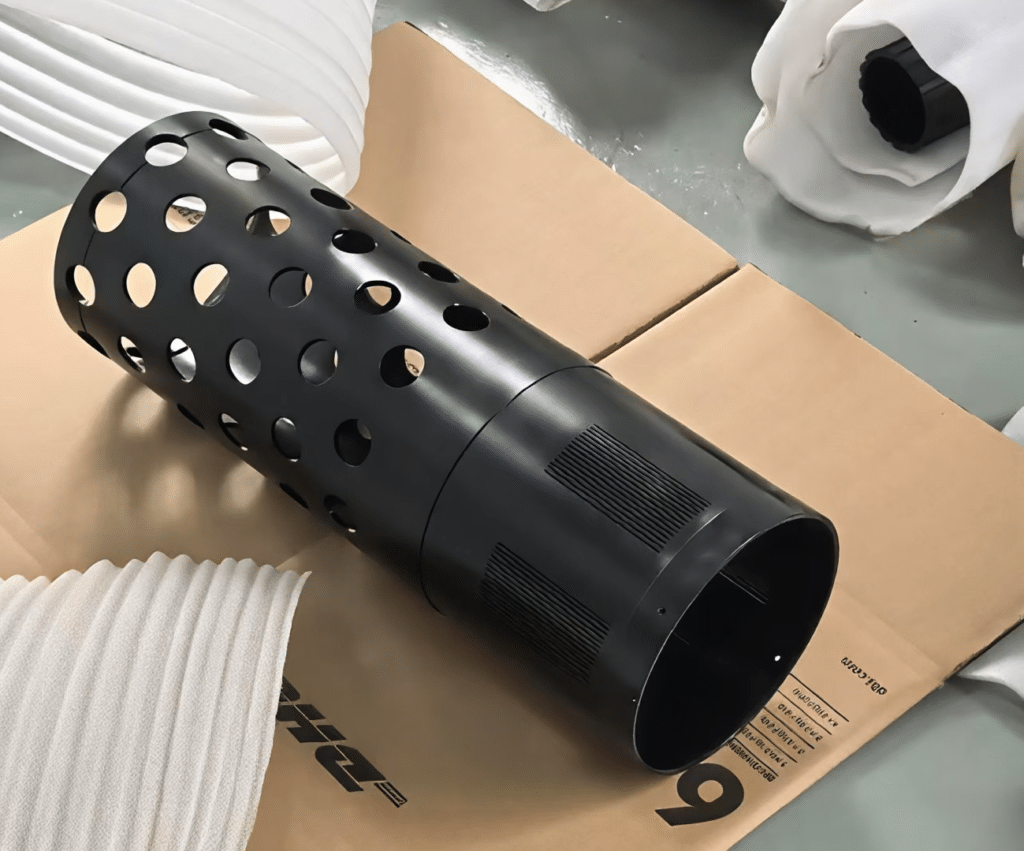
As we continue our journey in CNC machining export business, today we want to talk about one frequently asked surface finishing option: black oxide, commonly known as blackening. The part shown here is a large CNC-machined steel cylindrical tube with multiple perforated holes and fine groove features, finished with black oxide treatment. When communicating with overseas clients, we find there is a widespread misunderstanding of blackening. Many buyers assume black oxide equals permanent rust protection, and this wrong expectation often leads to disputes during ocean shipping and storage.
Black oxide, or blackening, is a chemical conversion coating applied to carbon steel parts. During treatment, a controlled chemical reaction creates a thin magnetite (Fe₃O₄) film on the steel substrate. Unlike paint or powder coating, this film is extremely thin and will not change the dimensional tolerance of your CNC machined component. That is one of its biggest advantages for precision CNC parts. For tight tolerance steel tubular workpieces, where adding extra coating thickness cannot be accepted, blackening becomes a popular surface finish choice.
The black oxide layer brings two main benefits. First, it provides mild corrosion resistance for indoor dry environments. Second, the matte black surface reduces light reflection and improves part appearance. It also helps hold lubricant or anti-rust oil on the metal surface, which is why many mechanical assemblies choose this finish.
However, here comes the critical limitation most customers overlook. The black oxide film is porous. Those tiny micro-pores on the surface cannot block moisture, salt spray or high humidity by themselves. Without extra sealing treatment, water vapor can penetrate through those pores and reach the base steel material. That explains why blackened steel workpieces still get rust if stored in humid warehouses or during long sea freight without proper protection.
Many overseas customers ask us: “If we choose blackening for our CNC steel parts, will they stay rust-free during ocean shipment?” Our standard answer is clear: black oxide alone cannot offer full rust prevention for export orders. To seal the porous oxide layer and activate its anti-corrosion performance, an anti-rust oil or wax sealing is mandatory after blackening. The oil fills all micro pores of the black oxide film and forms a sealed barrier against moisture. Only the combination of black oxide + post-sealing anti-rust oil can reliably protect the steel part in high-humidity shipping containers.
For our CNC tubular steel parts like the perforated cylinder in the photo, we strictly follow this process flow: CNC machining → deburring & cleaning → black oxide chemical treatment → full rinse → apply anti-rust oil for sealing. This complete workflow ensures the parts keep a uniform matte black look and survive long overseas transit.
We often compare black oxide with other surface treatments to help customers pick the right finish for their projects. Powder coating and painting create thick barrier layers with excellent corrosion resistance, but they add coating thickness and may affect precision dimensions. Zinc plating offers superior rust protection, but it changes the part dimension and has higher cost. Black oxide sits in a middle position: low cost, no dimensional shift, limited inherent corrosion resistance, relies heavily on post-sealing.
When you prepare drawings and specifications for CNC steel components for export, it is important to write your requirement clearly. Instead of simply marking “blackening finish”, we suggest specifying “Black oxide coating plus anti-rust oil sealing” on your technical drawing. This avoids miscommunication between manufacturers and buyers, especially for cross-border orders. It prevents the disappointment of receiving rusted goods after weeks of sea transportation.
For CNC machining exporters, technical communication about surface finishes is always essential. It is our responsibility to educate our customers on material and finishing properties before production starts. Clear technical consultation helps customers make informed decisions and avoid unexpected quality issues, delays or extra costs.
Our workshop specializes in custom CNC machined steel components, including tubular housings, perforated sleeves and structural parts, with various surface treatments: black oxide, zinc plating, anodizing for aluminum, powder coating. We support prototype, small batch and mass production for global clients. If you have a steel part project and need advice on surface finishing options, send your drawings to us for process evaluation.
In conclusion, black oxide (blackening) is an economical, dimensionally neutral surface finish for precision CNC steel parts, but it is NOT a permanent rust-proof coating. Always remember the rule: black oxide + anti-rust sealing oil, for reliable protection in humid or marine transport environments.
If you are sourcing custom CNC machined tubular steel parts, perforated sleeves or other precision steel components with black oxide or other surface treatments, feel free to contact our team. We provide full service including DFM review, process consultation, prototyping and volume production for global buyers. Simply share your CAD drawings, specifications and quantity requirements, and we will offer professional technical advice and competitive quotation for your project.