
1. Raw Material Is Non-Magnetic, But Machined Parts Are Magnetic?
Many customers test AISI 321 bar stock with a magnet and find no magnetism. But after CNC milling or turning, the finished part attracts a magnet slightly. Does this mean the material is defective?
The answer is: It is normal, and it is not a material defect.
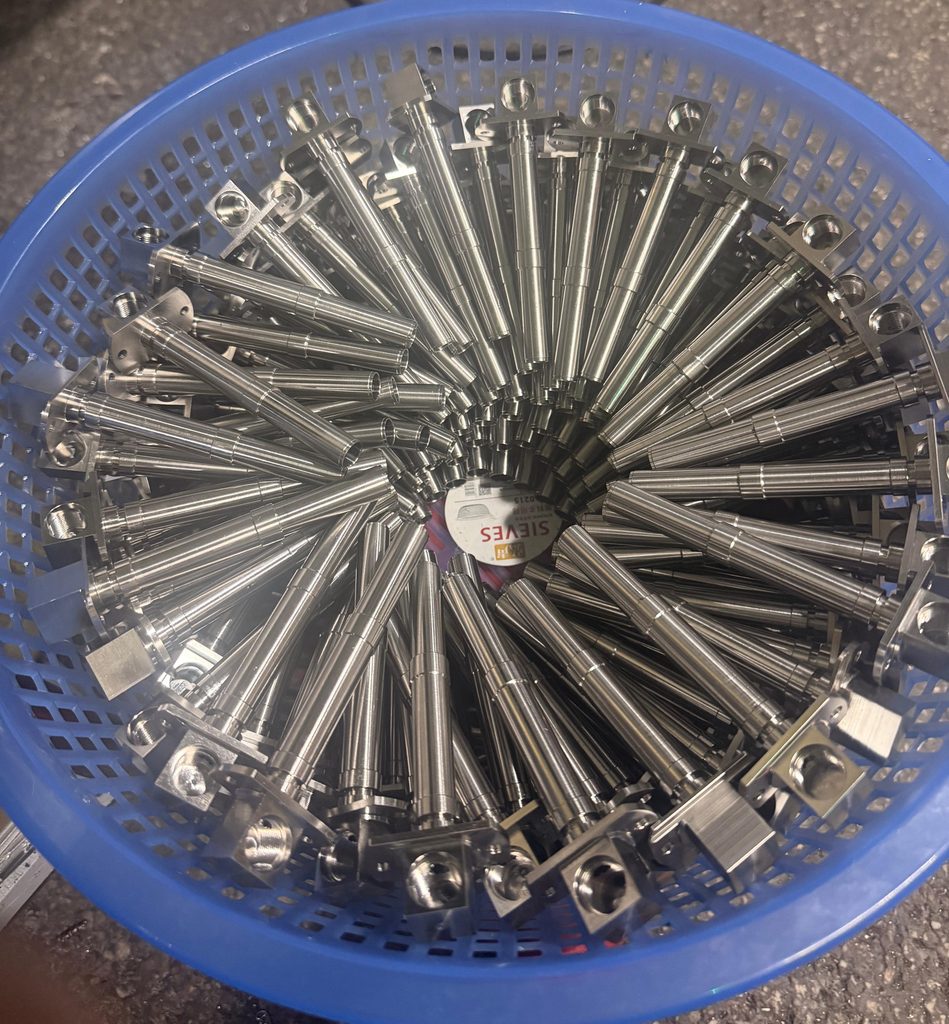
AISI 321 is an austenitic stainless steel. In the annealed condition, it is non-magnetic or only weakly magnetic. During CNC machining, cutting forces cause cold working on the surface. Part of the austenite structure transforms into martensite, which is magnetic. That is why the machined surface shows slight magnetism.
2. Will the Magnetism Disappear by Itself?
Usually no. The martensite formed during machining is relatively stable at room temperature. It will not automatically transform back to austenite just by sitting on a shelf. The magnetism stays unless you treat it.
3. Does Magnetism Affect Performance?
In most cases, slight magnetism does not affect mechanical properties, dimensional accuracy, or normal use. Many CNC machined parts have weak magnetism, and customers assemble them without any issue.
But in some cases, magnetism can cause problems:
- Vacuum chucks or magnetic fixtures
- Near sensors or magnetic-sensitive components
- Welding arc blow
- High-precision instruments or medical device parts
- Plating or coating adhesion issues
4. How to Fix It? Three Practical Methods
1. Solution Treatment (Most Effective)
Heat the part to 1050°C–1120°C, hold, then quench in water. Martensite transforms back to austenite. Magnetism is removed and corrosion resistance is restored. Best for parts with strict magnetic requirements.
2. AC Demagnetization (Surface Treatment)
Use a demagnetizer to remove residual magnetic field. It does not change the internal martensite structure. Suitable for weak magnetism or temporary needs.
3. Optimize Machining Process (Prevention)
Use sharp tools, reduce cutting forces, improve cooling, and minimize repeated passes. This reduces magnetization. It cannot fully prevent it, but keeps it very weak.
5. What Can Lenchor Do for You?
Lenchor specializes in CNC machining, offering CNC milling, turning, and custom stainless steel parts. We machine AISI 321, 304, 316, 17-4PH, and more. We understand magnetization in austenitic stainless steel and can adjust the process based on your magnetic requirements, with demagnetization or solution treatment if needed.
If you are looking for a reliable CNC machining partner, feel free to contact us.
Conclusion: Slight magnetism in AISI 321 after machining is normal and usually harmless. If your application is magnetic-sensitive, solution treatment or demagnetization can solve it. The key is to work with a machining partner who understands the issue.