
In the realm of modern surgery, the evolution from open procedures to minimally invasive surgery (MIS) represents a quantum leap. At the heart of this revolution are endoscopes and surgical robots—devices that grant surgeons “eyes and hands” deep inside the human body with minimal trauma. Their performance, however, hinges on an often-overlooked foundation: the exquisitely crafted metal components within. These are not just parts; they are enablers of precision, miniaturization, and sterility.
At Lenchor, we operate at the forefront of this niche, specializing in the extreme manufacturing challenges these life-saving tools demand. This blog delves into the triumvirate of challenges—miniaturization, complex geometry, and supreme surface finish—and how advanced manufacturing pushes these limits to empower the next generation of surgical innovation.
The Unforgiving Demands of the Human Body
The operating room is a merciless critic. Surgical components must be:
- Miniature: To traverse narrow anatomical pathways.
- Impeccably Cleanable: To withstand rigorous sterilization without harboring pathogens.
- Biocompatible: Often requiring materials like 316LVM stainless steel, titanium, or specialized alloys.
- Mechanically Robust: Possessing exceptional strength and fatigue resistance despite their tiny size.
- Precision-Fitted: With tolerances that ensure flawless, friction-free motion over thousands of cycles.
Failure in any aspect is not an option. This is where precision manufacturing transitions from a technical craft to a critical discipline.
Challenge 1: The March of Miniaturization – Manufacturing the “Micro”
Application Spotlight: Miniature Shafts and Pins
Think of the articulated wrists of a robotic surgical instrument or the control rods within a flexible endoscope. These miniature shafts, often sub-millimeter in diameter, are the tendons and bones of these systems.
The Manufacturing Limit-Test:
- The Problem: Machining a Ø0.3mm, 50mm-long titanium rod that must remain straight within ±0.01mm and sustain torsional loads. Conventional machining risks deflection, vibration, and heat-induced warping.
- Lenchor’s Approach: We employ Swiss-type CNC machining, a game-changer for micro-parts. With a guide bushing supporting the material microns from the cutting tool, we achieve unparalleled stability for ultra-slender turned parts. Combined with micron-precision tooling and specialized handling fixtures, we produce shafts, pins, and bushings that meet the most stringent dimensional and concentricity requirements for minimally invasive surgery instruments.
Challenge 2: Conquering the Internal Labyrinth – Complex and Irregular Cavities
Application Spotlight: Instrument Heads & Fluid Management Components
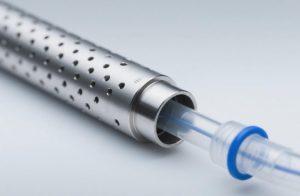
The functional intelligence of a surgical tool is often hidden inside. An electrocautery probe needs internal channels for wire routing. A suction/irrigation tool features intricate complex internal channels for bidirectional fluid flow within a diameter of just 2-3mm.
The Manufacturing Limit-Test:
- The Problem: Creating deep, cross-connected, or tapered irregular cavities with sharp internal corners and smooth transitions, all within a medical-grade stainless steel housing. Drilling deep, small-diameter holes is one thing; creating a three-dimensional internal network is another.
- Lenchor’s Approach: We leverage multi-axis CNC machining (5-axis) and advanced Electrical Discharge Machining (EDM).
- 5-Axis Milling: Allows us to approach the workpiece from virtually any angle, enabling the machining of internal features that are “hidden” from a standard spindle direction. This is crucial for creating off-axis ports and complex internal geometries in a single setup, ensuring perfect alignment.
- Micro-EDM: For the most delicate or hard-to-machine materials, EDM uses controlled electrical sparks to erode material. This is ideal for creating ultra-precise, burr-free internal features—like a 0.1mm wide channel in a carbide jaw—without introducing mechanical stress. It’s our solution for geometries where even the smallest cutting tool cannot reach.
Challenge 3: The Mirror Within – Achieving Medical-Grade Polishing
Application Spotlight: Endoscope Tubes & Optical Component Housings
Any surface inside an endoscope’s tube or in contact with tissue or fluid must be flawlessly smooth. Medical-grade polishing is not about aesthetics; it’s about safety and function.
The Manufacturing Limit-Test:
- The Problem: Achieving a surface roughness (Ra) better than 0.2 µm, often targeting Ra 0.05 µm or a mirror finish, on the inside of a long, narrow tube with internal steps or channels. Any microscopic pit or scratch can become a haven for bacteria (forming a biofilm) or cause tissue drag and trauma.
- Lenchor’s Approach: Polishing is a dedicated art form in our process. We utilize a staged methodology:
- Mechanical Micro-Deburring: Using custom-sized abrasive media to remove all machining burrs.
- Electropolishing: This electrochemical process is key. It uniformly removes a microscopic layer of material from the entire surface, preferentially dissolving peaks and edges. This not only improves Ra but also passivates the stainless steel surface, dramatically enhancing its corrosion resistance—a critical factor for repeated sterilization.
- Ultrasonic and Abrasive Flow Polishing: For internal paths, we use specialized techniques where a vibrating abrasive medium or a viscous abrasive paste is forced through the channels, polishing every internal contour to a consistent, high-gloss finish.
The Lenchor Synergy: Where Precision Meets Partnership
Mastering these individual challenges is one thing. Integrating them on a single component—a miniature shaft with an irregular cavity that requires a medical-grade polish—is where true manufacturing expertise is proven.
This requires more than just advanced machines; it demands:
- Holistic Process Design: Planning the manufacturing sequence backwards from the final polish, selecting the right raw material form, and designing custom fixtures to protect delicate features at every stage.
- Metrology at the Edge: Measuring these parts demands technology as advanced as our machining. We employ non-contact optical measuring systems, high-magnification digital microscopes, and specialized surface profilometers to validate internal dimensions and finishes that are virtually invisible to the naked eye.
- A Culture of “Micro-Vigilance”: From air-conditioned and clean production environments to specialized packaging, every step is designed to handle these precious micro-components without damage or contamination.
At Lenchor, we believe our role is to be an extension of your R&D and engineering team. We don’t just accept prints; we engage in Design for Manufacturability (DFM) dialogues early on. Can a radius be increased by 0.05mm to improve polishability? Could a slight change in feature orientation eliminate a secondary operation? Our goal is to help you push the physical limits of what’s possible in minimally invasive surgery instrument design, while ensuring reliability and manufacturability.
Conclusion: Enabling the Next Frontier of Surgery
The future of surgery lies in greater dexterity, smaller access points, and smarter instruments. This trajectory will continue to test the limits of micro-manufacturing, demanding even smaller scales, more complex material integrations (like polymers with metals), and surfaces so flawless they repel biological matter.
Are you designing the next groundbreaking endoscope or the next-generation surgical robot arm? The capabilities of your vision will be grounded in the realities of making its smallest metal components.
Push the limits with a partner who understands the edge. If you are exploring the boundaries of what’s possible in surgical device manufacturing, let’s discuss how Lenchor’s expertise in miniature shaft fabrication, complex internal channel creation, and medical-grade polishing can bring your most ambitious designs to life.
Contact the Lenchor team today for a confidential consultation on your micro-precision manufacturing challenge.